Homestead Lot Clearing Order: How the $250-a-Day Fine Actually Works
Got a Miami-Dade lot clearing order on a Homestead property? Here's how the $250/day fine compounds, what BNC really wants, and your four real options.
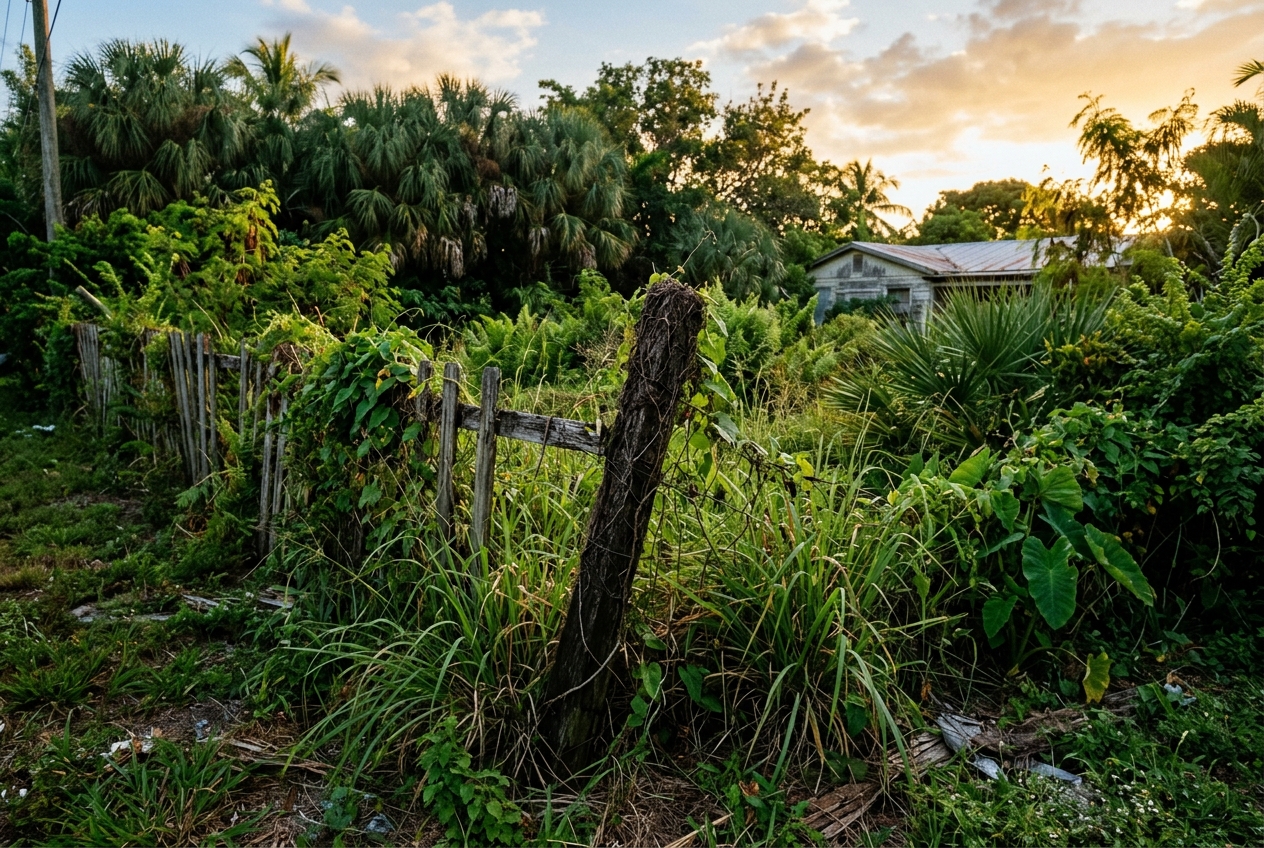
You got a notice from Miami-Dade Building & Neighborhood Compliance. Overgrown lot. Maybe trash. Maybe an abandoned trailer or a swing set someone left behind in 2019. The notice says you have a deadline to clear it, and after that the fines start.
You probably tossed it in the kitchen drawer for a week. That's fine. Most people do. But the meter is already running in the background, and the County does not forget.
Here is what the notice actually means, what the $250-a-day number really does to your equity, and the four things you can do about it.
What a lot clearing order actually is
In Miami-Dade, the agency that used to be called Code Enforcement is now Building & Neighborhood Compliance — BNC. Same job, new sign on the door. They handle overgrown lots, illegal dumping, junk vehicles, unsecured structures, and the general category of "this property is making the neighborhood worse."
A lot clearing order is the County telling you the property is out of compliance with Chapter 19 of the County Code. Usually it starts with a courtesy notice, then a Notice of Violation with a cure deadline, usually 10 to 30 days depending on the violation.
If you miss the cure deadline, the case goes to a Special Magistrate hearing. That hearing is typically scheduled 30 to 60 days after the notice. The Magistrate enters an order. After that, the fines accrue.
The $250-a-day math nobody explains
Under Miami-Dade's enforcement rules, daily fines on lot clearing and similar nuisance violations can run up to $250 per day for a first violation, and up to $500 per day for a repeat. Most Homestead cases I see come in at the $250 tier.
That sounds manageable until you do the math.
| Time since Magistrate order | Daily fine at $250 | Running total |
|---|---|---|
| 30 days | $250 | $7,500 |
| 90 days | $250 | $22,500 |
| 6 months | $250 | $45,000 |
| 1 year | $250 | $91,250 |
| 2 years | $250 | $182,500 |
Most of the Homestead lots I look at are worth somewhere between $80,000 and $180,000 raw. So a year of ignored fines can equal or exceed the value of the dirt. The County also tacks on administrative costs and, if they send a contractor to clear the lot themselves, the contractor invoice plus a markup.
The fine doesn't stop because you stopped opening the mail. It stops the day you cure, the day you settle at a mitigation hearing, or the day someone takes title at closing or auction.
That last line is the part that bites people.
The realistic timeline in Homestead
Homestead, Florida City, Naranja, Princeton, Goulds — this corridor sees a lot of these. Vacant lots from inherited family land. Old mobile home parcels. Lots that flooded and never got rebuilt after Andrew or after Irma.
A normal sequence looks like this:
| Stage | Roughly when | What's happening |
|---|---|---|
| Courtesy notice | Day 0 | Inspector flagged the lot |
| Notice of Violation | Day 10-20 | Formal cure deadline starts |
| Special Magistrate hearing | Day 45-75 | Order entered, fines begin |
| Lien recorded | 90+ days after order | County records the lien on the folio |
| Lien foreclosure eligible | After lien sits unpaid | County or assignee can move to foreclose |
Once a lien is recorded against the folio, it sits there. You can't sell normally without dealing with it. You can't refinance. And if there's also unpaid property tax on the same parcel, you've now got two clocks running.
The property tax clock matters because a tax certificate holder in Florida can apply for a tax deed after two years. Once they apply, the Miami-Dade Clerk schedules the tax deed sale, typically about 30 or more days out, and lists it on the Clerk's auction site. If that auction happens, the BNC lien, the certificate holder, the Clerk's fees, and the attorneys all get paid before you see a dollar of surplus. Usually there is no surplus.
Your four real options
Every Homestead homeowner with a lot clearing order has the same four choices. Pretending there are more is what marketing people do.
Cure it. Hire a lot clearing contractor. In Homestead you can usually get a vacant residential lot cleared for $600 to $2,500 depending on size, how grown-in it is, and whether there's debris or a structure. Take photos. Request a re-inspection through the BNC case number. If you cure before the Magistrate hearing, the fine usually never starts. If you cure after, you can request a mitigation hearing to reduce the accrued fine — sometimes the Magistrate cuts it to 10 or 25 percent of the running total. Sometimes not.
Fight it. Show up at the Magistrate hearing. Bring proof the notice was wrong, that the lot isn't yours, that you weren't properly served, or that you have a real hardship. This works more often than people think when the County's paperwork is sloppy. It does not work when the lot is in fact a jungle and you just don't want to pay.
Sell to us. This is what we do. HWV closes in seven days, cash, as-is. The BNC lien, the accrued fine, the back taxes, the Clerk fees if you're already in tax deed — all of it comes out at closing. You sign, you walk away with the net, the County gets paid by us, and the case closes. You do not clean the lot. You do not show up at the hearing. You do not pay the contractor.
Ignore it. Most common path, accidentally. The lien grows. If property taxes are also unpaid, a tax certificate holder eventually applies for the deed. The Clerk schedules the auction. The house or lot sells. You get whatever surplus is left, which on a Homestead lot with a five-figure BNC lien and unpaid taxes is usually zero.
| Path | Typical out-of-pocket | Time | What you keep |
|---|---|---|---|
| Cure | $600-$2,500 + accrued fine | 30-90 days | The property, minus cash spent |
| Fight | $0-$2,000 (lawyer optional) | 60-120 days | Depends on Magistrate |
| Sell to HWV | $0 | 7 days | Cash net at closing |
| Ignore | $0 today | 1-3 years | Usually nothing |
What most Homestead owners get wrong
Three things, over and over.
The first is thinking the fine pauses if you don't respond. It does not. The Magistrate enters the order whether you show up or not, and the daily accrual runs against the folio, not against you personally. You move to Georgia, you sell your other house, you change your phone number — the lien is on the dirt and it stays there.
The second is thinking they can wait until they're "ready to sell" and then deal with it. By the time you're ready to sell, the lien has often grown past the equity in the property. A title company will not close around it. A retail buyer's lender will not fund.
The third is paying a lot clearing contractor cash and assuming the County knows. They do not. You have to request the re-inspection and get the case formally closed. Otherwise the fine keeps running on a lot that is already clean.
What happens if you wait six more months
At $250 a day, six more months is another $45,000 on the lien. If your Homestead lot is worth $90,000 and you already have $15,000 in accrued BNC fines and $4,000 in back taxes, another six months can push the math underwater. At that point your only real exit is a cash buyer who knows how to settle BNC liens at closing, or the tax deed auction takes the decision out of your hands.
The lot doesn't get cheaper to clean. The fine doesn't reset. The County's patience isn't a strategy.
Sources
- Miami-Dade Building & Neighborhood Compliance — confirms BNC is the current name for what used to be Code Enforcement and outlines the violation process.
- Miami-Dade Code of Ordinances, Chapter 8CC (Code Enforcement) — sets out civil penalty schedules, including the $250 per day first-violation cap and $500 per day repeat-violation cap.
- Miami-Dade Clerk Tax Deed Auctions — confirms tax deed sales are scheduled and published online after the certificate holder applies.
- Florida Statutes Chapter 162 (Local Government Code Enforcement) — state-level framework for code enforcement liens and Magistrate hearings.
- Florida Statutes Chapter 197 (Tax Collections, Sales, and Liens) — governs tax certificates, tax deed applications, and the auction surplus order.
If you want a number on your Homestead lot, send me the folio and I'll have one back to you the same day. If you want to think on it, think on it. The $250 doesn't think about you either way.
— Maurice